What does it mean to have poor data quality?
Poor quality data is inaccurate data. It can take several forms: Missing contact fields (phone numbers, emails, physical addresses, etc.) Outdated information (old job titles, changes caused by mergers and acquisitions, etc.) Data entered in the wrong field.
What are sources of poor data?
Incomplete data sources
- Data is missing or unusable.
- Absence or incomplete availability of data collection tools.
- Linkages between data sources are missing.
What affects the quality of data?
There are five traits that you'll find within data quality: accuracy, completeness, reliability, relevance, and timeliness – read on to learn more.
What are some examples of data quality problems?
The 7 most common data quality issues
- Duplicate data. Modern organizations face an onslaught of data from all directions – local databases, cloud data lakes, and streaming data. ...
- Inaccurate data. ...
- Ambiguous data. ...
- Hidden data. ...
- Inconsistent data. ...
- Too much data. ...
- Data Downtime.
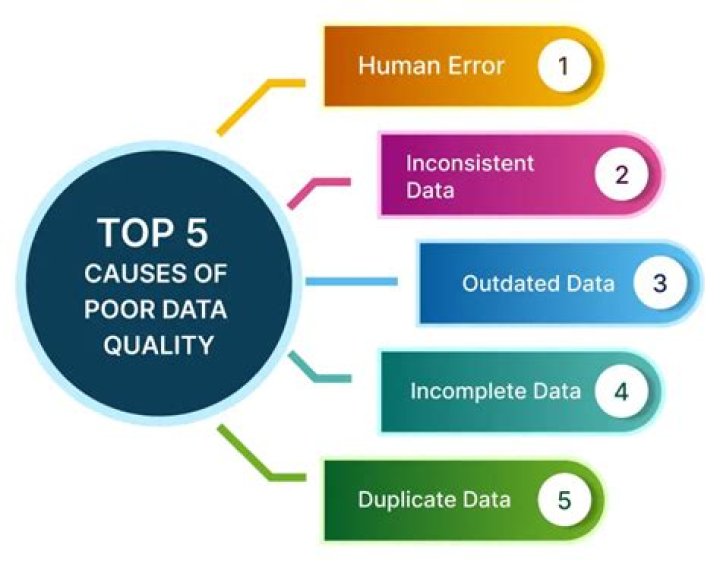
Ch 10 - Causes of Poor Data Quality
What causes data errors?
Hardware and software failure are the two main causes for data loss. Background radiation, head crashes, and aging or wear of the storage device fall into the former category, while software failure typically occurs due to bugs in the code. Cosmic rays cause most soft errors in DRAM.
How do I fix poor data quality?
Resolving Data Quality Issues
- Fix data in the source system. Often, data quality issues can be solved by cleaning up the original source. ...
- Fix the source system to correct data issues. ...
- Accept bad source data and fix issues during the ETL phase. ...
- Apply precision identity/entity resolution.
How do you improve data quality?
Below are our top tips for improving data quality to get the best out of your data investments.
- Tip 1: Define business need and assess business impact.
- Tip 2: Understand your data.
- Tip 3: Address data quality at the source.
- Tip 4: Use option sets and normalize your data.
- Tip 5: Promote a data-driven culture.
Which of the following can cause data inaccuracy?
Data Entry Mistakes
The most common source of a data inaccuracy is that the person entering the data just plain makes a mistake. You intend to enter blue but enter bleu instead; you hit the wrong entry on a select list; you put a correct value in the wrong field. Much of operational data originates from a person.
How do you check the quality of data?
What are the steps to data quality testing?
- Step 1: Define specific data quality metrics. Your organization needs specific metrics to test against to understand what you are targeting and need to improve. ...
- Step 2: Conduct a test to find your baseline. ...
- Step 3: Try a solution. ...
- Step 4: Assess your results.
What is data quality with example?
Data that is deemed fit for its intended purpose is considered high quality data. Examples of data quality issues include duplicated data, incomplete data, inconsistent data, incorrect data, poorly defined data, poorly organized data, and poor data security.
How can I improve my data connection?
- Move to a Different Location. Many physical factors can result in slow LTE or 5G. ...
- Update and Disable Network-Heavy Apps. ...
- Disable Data Saver or Low Data Mode. ...
- Remember Your Data Cap. ...
- Disconnect From Your VPN. ...
- Check for Network Outages. ...
- Reset Your Phone's Network Settings. ...
- Remove and Reinsert Your SIM Card.
What are the 2 most common causes of data loss?
The primary causes of data loss are: Human failure. Human error.
How do people lose data?
Most common reasons for data loss are connected to our everyday lives - the way we save, store and handle our data.
- Deleting files accidentally. ...
- Viruses and damaging malware. ...
- Mechanical damages of hard drive. ...
- Power failures. ...
- Theft of computer. ...
- Spilling coffee, and other water damages. ...
- Fire accidents and explosions.
What causes data leakage?
Weak and Insecure Passwords
This may seem quite obvious but weak passwords are the leading cause of data breach because such passwords can be cracked quite easily. According to a study conducted by Verizon, close to 48% of all data breaches happened with stolen passwords.
What is an example of data loss?
It is common for data to get “lost,” meaning for data to become corrupted or deleted by accident. For example, dropping your laptop hard drive can easily lead to data corruption, as can malware or a computer virus.
Why is my data being slow?
It might be due to lots of apps on your device or the hardware of the Smartphone might be outdated or inferior, such as cheap Android devices and older Smartphones. Even so, the type of applications on your phone, cheap or high-end can actually affect your browsing speed.
Why is my data connection so slow?
Running too many data-hogging apps and activities can clog your network bandwidth and reduce connection speed. So, if you're streaming Netflix, downloading multiple files, and updating your apps simultaneously, pause some of these activities and run them one at a time.
Why is my 4G data so slow?
One potential cause of a slow download speed whilst having good signal is deprioritization. Operators “deprioritize” some users at busy times to help deal with network congestion, but that deprioritization can happen differently for users on different rate plans.
What are the 4 categories of data quality?
- Assess. Poor data quality and data quality management impact the business through inefficiencies, errors, additional costs or even fines. ...
- Remediate. ...
- Enrich. ...
- Maintain.
What are the three critical components for determining data quality?
There are five components that will ensure data quality; completeness, consistency, accuracy, validity, and timeliness. When each of these components is properly executed, it will result in high-quality data.
What are the 7 dimensions of data quality?
These have also been adapted to the OECD context. Thus, the OECD views quality in terms of seven dimensions: relevance; accuracy; credibility; timeliness; accessibility; interpretability; and coherence.
How important is data quality?
Because data accuracy is a key attribute of high-quality data, a single inaccurate data point can wreak havoc across the entire system. Without accuracy and reliability in data quality, executives cannot trust the data or make informed decisions.
What does data quality mean?
Data quality is a measure of the condition of data based on factors such as accuracy, completeness, consistency, reliability and whether it's up to date.
What are the 5 metrics of quality data?
The dimensions explored in the DQAF include completeness, validity, timeliness, consistency, and integrity. Data quality dimensions are important because they enable people to understand why data is being measured. Specific data quality metrics are somewhat self-explanatory.