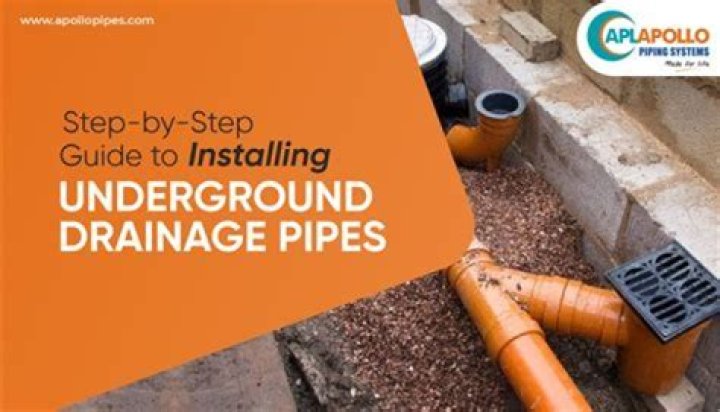
Steps to Install Drainage Pipe
- Step One: Mark Installation Area. Before you begin, clearly mark the path for the installation of the drainage pipe. ...
- Step Two: Dig a Trench. Dig a deep trench where you plan for the drainage to end. ...
- Step Three: Attach Pipe. ...
- Step Four: Fill Trench.
How deep should drainage pipe be buried?
Maintaining a depth of 12 to 18 inches is best for drain pipes, but the depth of the pipe may vary in order to maintain a downward slope, which is critical for proper drain functioning.
Do I need gravel for solid drain pipe?
Why do I need the extra drainage in gravel: If the pipe connection has a flaw or if the ground shifts a pipe crack could form. If the pipe is backfilled directly with soil the water will collect against the pipe and soil without somewhere to go.
What is the best pipe to use for underground drainage?
Polyvinyl Chloride pipes (PVC) are the best choice for underground drainage due to their durable nature. PVC pipes are malleable and come in almost any size. These pipes can withstand lots of environmental and water pressure and last for very long periods.
What is the minimum slope for water drainage?
Regardless of surface characteristics, when it comes to surface drainage, slope is the most important issue to consider. For efficient drainage, paved surfaces should have a minimum 1-percent slope. Turf or landscaped areas should have a minimum slope of 2 percent.
Proper Installation of Landscape Drainage Pipe
Should I use corrugated pipe for drainage?
While landscapers use “non-rigid corrugated NDS pipes,” we use drainage grade PVC pipe because it is more durable and longer-lasting, especially when buried under heavy materials like soil. The corrugated pipe is cheaper but not nearly as strong.
How big drainage pipe do I need?
Using either 3″, 4″ or 6″ drainage pipe is recommended on most residential and light commercial projects as these pipe sizes and applicable fittings are readily available and easy to install.
How do you dig a trench for drain pipe?
Dig a trench that is 18 inches deep and 9–12 inches wide. Lay water-permeable landscaping fabric in the trench, followed by 3 inches of gravel. Lay your perforated drain pipe in the trench, cover with an additional 3 inches of gravel, and cover the drainage ditch with rocks, soil, or stones.
Can you bury PVC drain pipe?
PVC and CPVC piping can be installed underground, but the installation must follow all ordinances, regulations, and codes. If you're planning on installing PVC and CPVC piping, make sure to pay special attention to local pipe installation techniques since it will be installed deep within a wide range of sub soils.
Can you bury the end of a drain pipe?
Expose the low end of the drain pipe if possible. This can be done by having it exit through the side of a hill into a natural valley. If this isn't practical, you can simply bury the end of the pipe in an area close to a storm drain or with softer soil that will absorb more water.
How deep can you bury corrugated drain pipe?
Based only on personal experience, not any sort of reference, 6" cover (so a 10 inch trench depth for a 4 inch pipe) is a reasonable minimum unless your lawnmower is one of those things that weighs as much as a small car.
Should you use PVC or corrugated pipe for drainage?
There is a reason all plumbing you might find in a home or business is smooth-walled, whether it's ABS, cast iron or PVC. So, for preventing clogs and keeping your drain water flowing long term, pvc is the winner over corrugated pipe.
How do you bury PVC pipe?
Professionals suggest PVC pipe be laid above at least two inches of underlayment. Underlayment can be made of rocks, concrete or plastic. To calculate the depth of the trench, add two inches to the diameter of the pipe and then add 18 inches to the total. This will give you the depth of the trench in inches.
How do you Slope a PVC drain pipe?
For 4-inch PVC piping and a building sewer less than 50 feet long, the minimum slope is 1 inch in 8 feet, or 1/8-inch per foot, and the maximum is 1/4-inch per foot. For sewers longer than 50 feet, the slope should be 1/4-inch per foot.
How do you find the slope for ground drainage?
To determine if you have proper drainage, check the slope from your foundation. Healthy drainage occurs when the slope is between 2 percent and 5 percent, which equates to 2 to 5 inches of drop-off for every 10 feet you measure as you move away from your home.
How do you calculate drainage?
To calculate the volume of water that needs to be stored, multiply the amount of runoff from each drainage zone by 15. The runoff for each zone was in gallons per minute. Multiplying by 15 minutes leaves you with the amount of gallons to be stored.
How do you calculate flow in a sewer line?
The Continuity equation and the Manning equation for steady-state flow can be used to calculate flow in a sewer pipe: Continuity Equation: Q = V*A Where: Q = peak flow, cubic feet per second (cfs). V = velocity, feet per second (fps).